|
|
             |
Keynote Speakers:
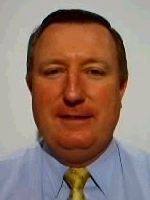
Ross Henricks (General Manager, Telstra, Australia)
| Keynote title: Telstra Next Generation Content Delivery Network |
Abstract: Telstra has over six years experience in the operation of a Content Delivery Network (CDN), to deliver BigPond content and other Telstra-branded media to customers. To address the growing demand for online and user-generated video content, coupled with improvements in broadband technologies and the increased availability of media-rich content, Telstra is introducing the Next Generation Content Delivery Network (NGCDN) for the most efficient movement of digital assets across its networks, on a massive and ever increasing scale. The NGCDN capability is fundamental to Telstra's role in running its own content business and the delivery of Telstra-branded product offerings such as BigPond movies. The NGCDN is also particularly relevant to Telstra's future in a post-NBN environment, as we focus on the creation of new services that are valued by our customers and drive new revenues. For this reason, Telstra's NGCDN is now being offered as a product to media, enterprise and government customers who want a scalable, managed way of delivering digital content to their users. In this keynote, the journey through building process of the NGCDN will be captured. The presentation is divided into four parts to demonstrate the rationale for NGCDN, challenges faced, structure of Telstra's CDN business and future roadmap. |
| Ross Henricks's Bio |
Ross Henricks is the General Manager and Technology Owner of Content Delivery Network at Telstra. He has over 30 years of experience in the Telecommunications industry. He is responsible for providing leadership for several teams within Telstra, as well as contributes to the decision and policy making for the company as a whole.
Ross is currently overseeing the design and development of highly available large-scale distributed systems such as Content Delivery Network (CDN) and Digital Video Network (DVN). He has been a key contributor in Telstra's major technology innovations such as Foxtel Digitisation, Hybrid fibre-coaxial (HFC) rollout and Telstra NGCDN. He holds a First Class Honors degree in Communication Engineering from RMIT University. |
Professor David Abramson (Monash University, Australia)
http://www.csse.monash.edu.au/~davida

| Keynote title: Assertion based parallel debugging |
Abstract: Programming languages have advanced tremendously over the years, but program debuggers have hardly changed. Sequential debuggers do little more than allow a user to control the flow of a program and examine its state. Parallel ones support the same operations on multiple processes, which are adequate with a small number of processors, but become unwieldy and ineffective on very large machines. Typical scientific codes have enormous multi-dimensional data structures and it is impractical to expect a user to view the data using traditional display techniques. In this seminar I will discuss the use of debug-time assertions, and show that these can be used to debug parallel programs. The techniques reduce the debugging complexity because they reason about the state of large arrays without requiring the user to know the expected value of every element. Assertions can be expensive to evaluate, but their performance can be improved by running them in parallel. I demonstrate the system with a case study finding errors in a parallel version of the Shallow Water Equations, and evaluate the performance of the tool on a 4,096 cores Cray XE6. |
| Professor David Abramson's Bio |
| Professor David Abramson has been involved in computer architecture and high performance computing research since 1979. Previous to joining Monash University in 1997, he has held appointments at Griffith University, CSIRO, and RMIT. At CSIRO he was the program leader of the Division of Information Technology High Performance Computing Program, and was also an adjunct Associate Professor at RMIT in Melbourne. He served as a program manager and chief investigator in the Co-operative Research Centre for Intelligent Decisions Systems and the Co-operative Research Centre for Enterprise Distributed Systems.
Abramson is currently an ARC Professorial Fellow; Professor of Computer Science in the Faculty of Information Technology at Monash University, Australia, and science director of the Monash e-Research Centre. He is a fellow of the Association for Computing Machinery (ACM) and the Academy of Science and Technological Engineering (ATSE), and a member of the IEEE.
Abramson has served on committees for many conferences and workshops, and has published over 200 papers and technical documents. He has given seminars and received awards around Australia and internationally and has received over $8 million in research funding.
He also has a keen interest in R&D commercialization and consults for Axceleon Inc, who produce an industry strength version of Nimrod, and Guardsoft, a company focused on commercialising the Guard relative debugger.
Abramson's current interests are in high performance computer systems design and software engineering tools for programming parallel, distributed supercomputers and stained glass windows.
|
|
|