CSS 2026
The 16th International Symposium on Cyberspace Safety and Security
Macau, China
| August 3-5, 2026

Call For Paper
The 16th International Symposium on Cyberspace Safety and Security (CSS 2026)
seeks submissions presenting novel contributions related to all theoretical
and practical aspects related to Cyberspace safety and Security communities
and their applications. The aim of CSS is to provide a leading-edge forum to
foster interaction between researchers and developers with the Cyberspace
safety and Security communities, and to give attendees an opportunity to
interact with experts in academia, industry, and governments. Authors of each
accepted paper must ensure that at least one author registers for the conference,
and that their paper
is presented in-person only at the conference.
Since the first CSS held in Sydney 2008, CSS has been successfully held in:
Chengdu, China (2009), Melbourne, Australia (2012), Zhangjiajie, China (2013),
Paris, France (2014), New York, USA (2015), Granada, Spain (2016), Xi'an,
China (2017,2022), Amalfi, Italy (2018), Guangzhou, China (2019), Hainan,
China (2020), Copenhagen, Denmark (2021) and Hangzhou, China (2025). This year we have CSS held in the
beautiful city Macau.
Topics of interest include but are not limited to:
- AI security
- Applied Cryptography
- Anti-malware techniques: detection, analysis, and prevention
- Biometric security
- Blockchain and Distributed Systems
- Cloud computing security
- Mobile and wireless network security
- Operation system security
- Privacy and anonymity in networks and distributed systems
- Quantum computing security
- Quantum cryptography
- Quantum key distribution
- Quantum-resistant cryptography
- Security Usability and Measurement
- Side Channels, and Cyber Physical Systems
- Security and privacy for blockchains and cryptocurrencies
- Security and privacy of mobile platforms
- Secure multi-party computation
- Security for cyber-physical systems
- Security for emerging networks
- Security architectures
- Software/firmware/hardware security
- Trustworthy computing
- Web security
Paper Submission Information
Authors are invited to submit original papers: they must not
substantially duplicate work that any of the authors have
published elsewhere or have submitted in parallel to any other
conferences that have proceedings or any journal. The submission
must be anonymous, with no author names, affiliations,
acknowledgements, or obvious references. Papers must be clearly presented in English,
Please ensure that your papers are in the single-column LNCS format, with full papers between 12 to 15
pages,
and short papers and poster papers no more than 6 pages.
All submissions must be received
by 11:59 PM AoE (UTC-12) on the day of the corresponding
deadline.
Springer CSS Author Information
Previous CSS Proceedings on SpringerLink
Camera-Ready
After the paper review process is completed, the acceptance notification for the CSS 2026 papers will be
sent to the authors' email. Authors will be requested to carefully review the reviewers' comments and read
the "camera-ready paper and copyright submission" email. The submission email address will be announced
later.
Please ensure compliance with the LNCS Word/LaTeX format templates (available in the "Springer LNCS Author
Information" section). The paper length should ideally be between 12-15 pages. Follow the instructions in
the email and submit the required materials. The copyright form will be provided to authors upon paper
acceptance.
LNCS_ProceedingsPaper_LTP_ST_SN_Singapore.docx
Springer_Instructions_for_Authors_of_Proceedings_CS.pdf
Publications
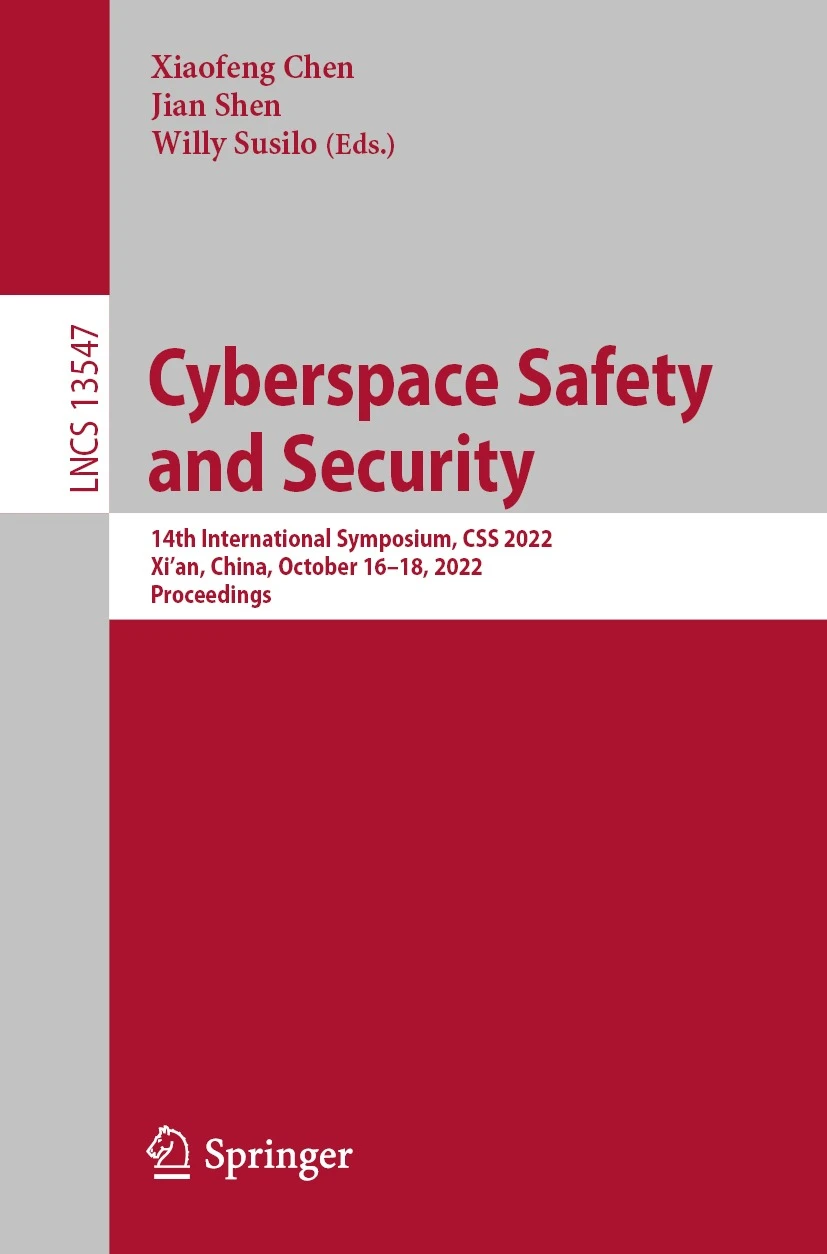
The proceedings of CSS 2026 will be published by Springer as a volume of the Lecture Notes in Computer Science (LNCS) series and indexed by EI Compendex. The previous editions of CSS proceedings on SpringerLink can be accessed through the following links.
Please note that at least one author of each accepted paper should register with full rate to the conference and give a presentation at the conference. Failure to register or absence from the presentation will eventually make your paper NOT being included in the conference proceedings.